
ABOVE AND BEYOND
INTERVIEW WITH DEF LEPPARD’S STEVE CLARK AND PHIL COLLEN.
Hit Parader magazine | September 1988 – Interview by Hank Thomson. Photo by Ken Settle
Steve Clark and Phil Collen are both quiet, unassuming guys caught up in the three-ring circus known as Def Leppard. On one side they’re flanked by the human quote machine, vocalist Joe Elliott; on the other, by media darling, drummer Rick Allen, who’s wowed the rock world with his amazing recovery. But Steve and Phil wouldn’t want it any other way. These two guys believe in the time-honoured axiom of letting their music do the talking – and judging by their work on the multi-platinum Hysteria, their “words” are reaching the metal masses loudly and clearly. Still, we weren’t satisfied just listening to this guitar duo’s riffs – we wanted to get the low down on the band’s current world tour from their own unique perspective. So, being the good journalistic troopers that we are, we recently trudged out on the road with Def Leppard to hook up with Clark and Collen.
Hit Parader: Do you feel you get the respect you deserve as guitarists?
Phil Collen: We do get ignored a bit because of the type of music we play. Some people look at us as a very commercial band – which we are in some ways – and because of that they don’t give us the kind of recognition we’d like. It’s kind of a drag.
Steve Clark: I think our playing is noticed and appreciated by the fans, which is really more important than having the critics love our playing. Hysteria is the kind of album that is a guitarist’s dream, because it has so many different styles within the songs. We’re very satisfied with the music we make which, to me at least, is more important than getting all the critical raves.
HP: Do you find you’re still improving as instrumentalists at this point in your career?
PC: We’re both improving by leaps and bounds. When you sit on the tour bus or in your hotel room and play for a couple of hours, then play at soundcheck, then play for two hours during the show, you’d better improve or something’s wrong with you. When you’re not on the road – and Def Leppard was off the tour circuit for about three years, as most everyone knows – you can get a bit lazy with your practicing, but when you’re on the road, you live, eat and breathe the music.
SC: Once you work out a guitar part for an album, you tend to stick with it for a while onstage – just because you think people expect that from you. But after you’ve been onstage for about four months, you notice that your solos have changed. They evolve naturally. I never set out and say, “Tonight I’m going to try something different.” That just happens because you become more comfortable with the material, and you do get a little better as a guitarist. Sometimes whole songs can evolve like that.
HP: Is there one particular song this time that’s changed onstage from its album version?
PC: Yeah, Pour Some Sugar On Me – which also happens to be our latest single and video – has really improved from the version that’s on Hysteria. I’m certainly not saying the album track isn’t really good but, to our ears, it just is a much stronger track now. It’s hard for me to put my finger on exactly why that’s true, but every time we play it, we all just break into smiles.
SC: Another one is Bringin’ On The Heartbreak. That song’s changed a great deal since we recorded it, but that was more by plan than by chance. The honest truth is that we got incredibly bored playing it the way it was, so we started using an acoustic guitar in the beginning and building up to the electric part. It really breathed new life into that song.
PC: Usually, our attitude is that when we get really tired of a song, we just leave it alone for a while. But Heartbreak was one we knew we had to play or the fans would riot on us, so the change was necessary. We keep changing our live set just so we stay really into it. We’ve dropped things like Love And Affection and Armageddon It, which were in the set we started out with in Europe. Then a few months back we dropped Hit And Run, because the set was getting to be two hours long.
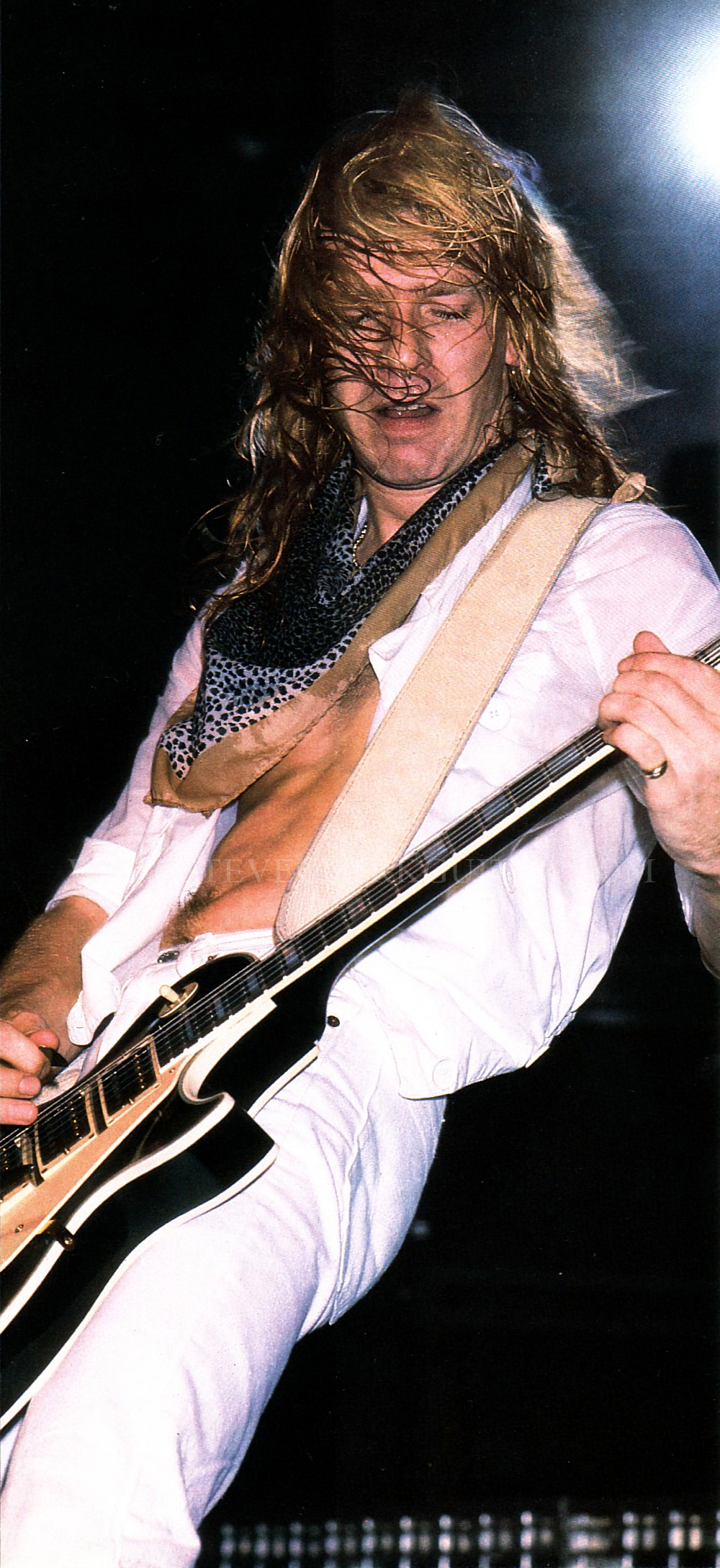
Photo: Ross Halfin
HP: So playing night-in and night-out can get to be a drag?
SC: Not really; we enjoy it immensely. But when you do start to get tired of playing a song, you’ve got to move on to something else. That’s the only way to keep things really sounding fresh. If your heart isn’t into a song, it’ll sound like crap. We figure that most of the people in the arena know Pyromania and Hysteria better than our earlier albums, so that’s where the material comes from. It’s our job to make the show exciting every night.
HP: After not touring for so long, has it been difficult getting back on the road?
SC: Nah, we’ve enjoyed every minute of it – and I mean that. When you haven’t played in a long time, you really begin to appreciate how wonderful the road is. You really do miss the fans and the excitement – and even the travelling. You’ll never hear any of us say something bad about touring, because we know all too well what it’s like when you’re not on the road for a very long time.
PC: We want to kiss the stage every night when we go up there. We really hated being in the studio after a while, so we never complain about playing live. Anyway, with the great stage we have to work on this time – with it right smack in the middle of the arena – every night presents new challenges and new musical victories.
HP: I know this is a horrible question to ask a band after they spent the better part of a year recording their last album, but have you begun thinking about the next album yet?
SC: If you’re asking are we going to take four more years to get the next one done, the answer is bloody hell, no! But we really haven’t done much work for the next one yet. We do have some loose ideas floating around, and we’re always writing new songs, so I don’t think we’ll have any problem. But with this band, you just never know when something unexpected will pop up. But we feel at this point, that we can handle anything and everything that’s thrown our way.



 David Plastik


