
WHY THE CORRECT WAY MATTERS:
A CLOSER LOOK AT WHY STEVE CLARK’S COMPOSITIONS SHOULD BE PLAYED HIS WAY.
by STEVE CLARK GUITAR | 2026 – Photos by Ross Merino and Ross Halfin.
When playing Def Leppard songs written by Steve Clark, the correct approach is to play the parts as he composed them. His chord voicings, note choices, phrasing, timing, dynamics, use of space and even effects were deliberate—not arbitrary. Each element was designed to create a particular tone, texture, and emotional impact within the arrangement. Changing those details may produce a valid personal interpretation, but it is no longer the part as Steve wrote it. In that sense, it is not simply “different”; it is inaccurate to the original composition. To reproduce the song faithfully, the specific way Steve intended the part to be played matters, because those choices are fundamental to the sound and character of the music.
This is also why a formally trained or otherwise highly knowledgeable musician may be more likely to recognise and appreciate these details than someone who has learned mainly by ear without studying the underlying theory and technique. A qualified musician can often identify how voicings, intervals, rhythm, articulation, dynamics, and tonal choices interact within the arrangement, and therefore understand why changing even a seemingly minor detail can alter the intended result. That does not mean a self-taught musician cannot develop the same insight, but formal study can provide the technical vocabulary and analytical framework needed to understand more fully why Clark’s parts were constructed in such a specific way.
Others who have studied Clark’s work have made the same point (as we will see below). Their insights have helped me develop a deeper understanding of why a composition should be played as written if the aim is to convey its true essence or intrinsic nature. The same principle applies, for example, to the compositions of Jimmy Page. Page wrote his songs in a particular way too.
Both Phil Collen and Ross Halfin have spoken of how Steve Clark could play Page’s work exactly, compared to many others who have tried to play but have not managed to pull it off correctly. The key to this will be his musical training.
And if it’s wrong with Page’s work, then it’s also wrong with Clark’s work!
Why the Correct Way Matters
For years, I have tried to make this point in discussions about Steve and his music. In the article I added to the website from the November 1995 issue of Japan’s Guitar Magazine, the author reiterates exactly the same point. It is also something the late Joe Scott [Hurricane Joe] referenced in the interview I conducted with him years ago. They both explain it much better than I ever could.
But the basic point is that, to play Steve’s parts exactly as he intended them, you will likely need an understanding of modes and scales and be schooled in music to some degree. To make those parts sound like the way Steve made them sound, they must be played as he wrote and intended them to be played. Otherwise, the result is incorrect and will not sound exactly right.
Perhaps this is why the Clark-era songs played by today’s version of Def Leppard don’t sound the same as they did in Clark’s day? A lot of the dynamics and arrangements have been altered since Steve Clark’s playing days, not to mention that some songs are down tuned which completely alters the overall sound. The basic song is there but it does not retain the characteristics of the original composition. Switch 625 is a glaring example.
People often respond by suggesting an alternative approach is not wrong, but simply different. Yet that is precisely the issue: when the purpose is to reproduce Steve’s original part, it is wrong because it is different. And I think this is why some Clark fans have difficulty listening to the band playing his works live these days. It’s generally the same song… but it’s not played the way he wrote it and intended it to be played. And you can hear the difference.
A lack of musical training can lead someone to find an alternative or simplified way to play a song. Such an approach may sound quite close at times, especially to the casual listener or untrained ear, but it is not correct, and the altered or alternative notes, voicings, techniques, or phrasing inevitably affect the tone and texture of the song.
“If you’re writing music, writing songs like ‘Bringin’ On The Heartbreak’, [and] if you’ve got a knowledge of scales and chords, then you can come up with…, not all that [standard] bullshit…, then you got a bit more knowledge on how to create a good sequence.” ~ STEVE CLARK, 1983.
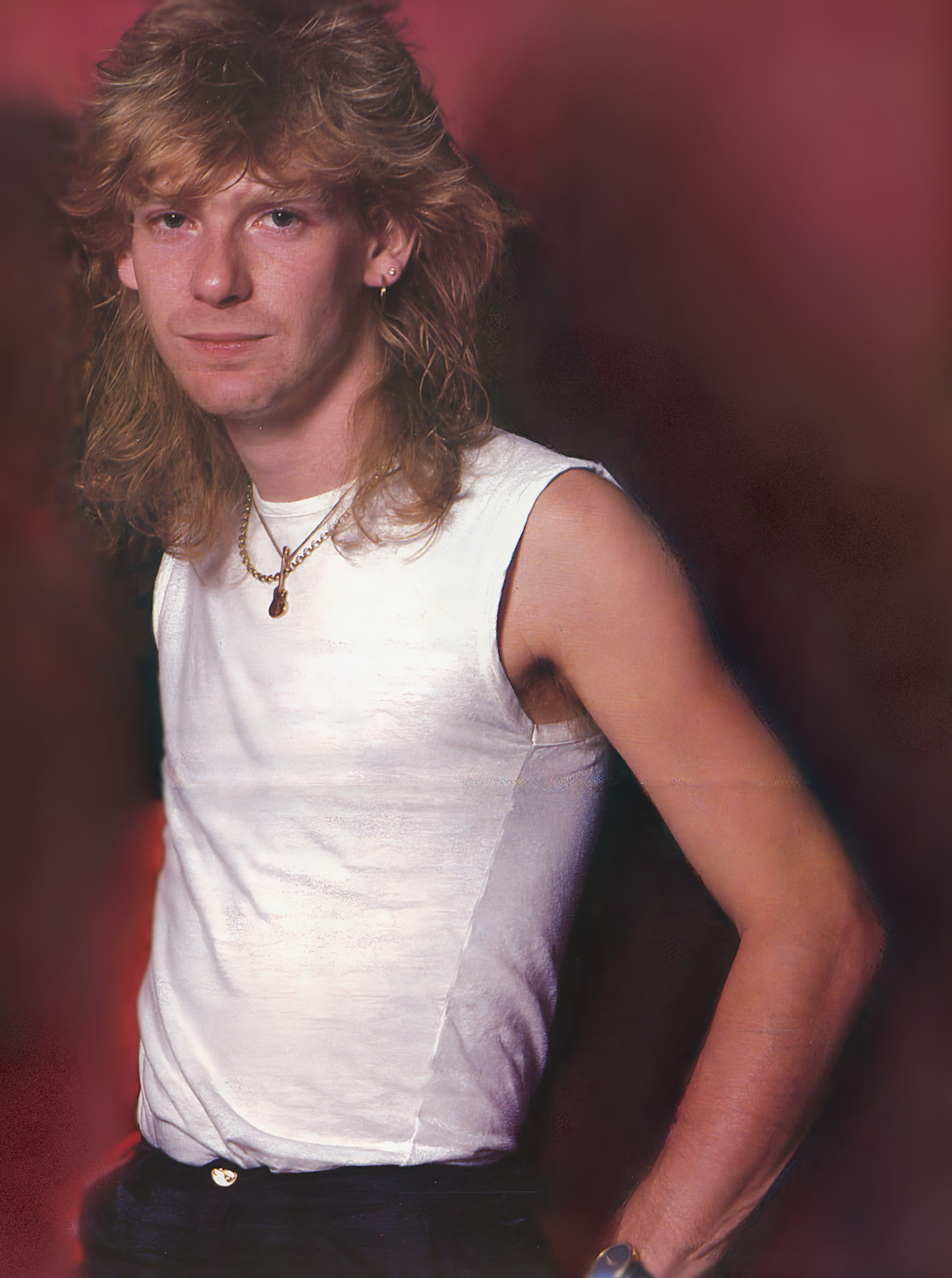
Here’s some true explanations of what I’m trying to say about why the correct way matters:
- “Steve has such a great knowledge of music and distinct chordal sound that was unique. Steve always played inversions in his chords. It was never the standard chord, so it makes it very hard to correctly learn how to play a Def Leppard song during the Steve era because of his style. You can get something to sound like it, but unless you learn inversions, it will never be exact.” [Hurricane Joe]
- “Just like Phil’s favourite solo of Steve, and a lot of people’s favourite work of Steve’s is Die Hard The Hunter; as great as that solo is, it’s nowhere near as hard as Steve’s Wasted solo, but Phil loved it because it was a better piece of music and well-orchestrated, not just for technical prowess. [Hurricane Joe]
- Steve was so different from other guitar players especially in his rhythm work or chordal structures. Steve got that from a combination of his classical guitar study and Jimmy Page. A perfect example of Page’s complexity that many guitarists miss and only the skilled ears can pick up is a song like Communication Breakdown. The song is played wrongly by 99% of guitarists out there. They play the open E string which is correct and then play a power chord or standard major chords of D A D. Jimmy actually plays the power D chord in the fifth position D on the fifth string, 5th fret and A note on the 4th string 7th fret. Then he plays the F-shaped A major chord on the fifth fret. This chord is made by playing the A on the 1st string 5th fret, then the E note on the 4th string 5th fret, then the C# note on the 3rd sting 6th fret, then the A note on the 4th string 7th fret. You can’t get that song exact unless you play it like Page. Steve’s work was just like that, and that’s why you can easily tell the difference between Steve and Vivian [Campbell], not because Steve was sloppy, it was because he was complicated! Listen to Billy’s Got A Gun (live) – the section after his first solo, before Phil’s – it’s the weirdest chords ever. I challenge anyone to learn that by ear.” [Hurricane Joe]
- “The arpeggios that incorporate open strings to create the sound of adjacent chords, as seen in songs like Photograph and Hysteria play an important role in Def Leppard’s music. Playing adjacent notes simultaneously can, in some cases, mean a fine line away from dissonance. But that is exactly why it creates that sense of tension. For example, a standard arpeggio progressing from the 1st, 3rd and to the 5th intervals may feel stable, but lacks tension. However, chords played with semitones or whole-tone intervals possess a special sense of clarity, which is really designed to pique the listeners interest. For those who want to create a song in the style of Steve Clark / Def Leppard, it is worth keeping the key phrase “adjacent chord arpeggios involving open strings” in mind, though it comes with the caveat that you have to understand the key points of how to utilise them.” [Masaki Fukuda, Guitar, Japan 1995]
- “For example, if you combine the chord Am with the chord Cmaj9, you get the sound of Am9. When two chords are combined in this way to achieve another chord, their constituent notes intertwine subtly, creating a tone that is different from when playing Am9 on a single guitar. Even with a single guitar, if you use a different fingering, the same chord will sound different, which is to be expected (the chord itself is the same, but the way the sound spreads out will be completely different depending on the fingering used).” [Masaki Fukuda, Guitar, Japan 1995]

As I mentioned above, when Phil Collen and Ross Halfin both spoke about how Steve could play Jimmy Page better than anyone else… note for note… this was Steve playing Jimmy’s work correctly – exactly as it was written and intended to be played, whereas many other guitarists would play it wrong, because they couldn’t get it exact. It is the very same thing with Steve’s compositions.
- “He’d always be playing a [Led] Zeppelin song. You know… he’d know the whole thing. Again, you know, a lot of players – they hear it and they don’t hear the real song. They kind of… their interpretation, it’s usually wrong. Steve actually nailed it on the… on the head! Like that was exactly what Jimmy Page played. And this was in the days before you could like um… get the DVD and kind of slow it down and break it down. This was just [him] listening to the records and stuff. So he’d be playing that all the time… any Zeppelin thing really.” [Phil Collen]
- “The thing you don’t realise about Clark… you could ask him – Any Led Zeppelin song and he could play it note for note perfectly. As good as…listening to a Led [Zeppelin record], he could just play it. He knew it all down.” [Ross Halfin]
- “We also kinda developed – and this was actually Steve’s idea, but we kinda developed this harmony chord thing. We never really played the same thing at the same time. Again, it wasn’t like a lead player and a rhythm player. We were kind of making an orchestrated sound. So that was very special. He’d come up with these ideas… ‘well what about orchestrating the guitars?’” [Phil Collen]
In order to be able to orchestrate the guitars in the way Steve did, one would have to have some musical training. As I’ve said many times before… this is why Def Leppard’s early albums from the Clark-era, are what they are – because of Clark’s musical knowledge when composing the songs. Yes, he worked closely with Collen on ideas for Hysteria, but he was the one with the knowledge to orchestrate the music and give it the dynamics and textures according to the rules. He was the guiding force behind the music and the only member of Def Leppard to have proper musical training. Which is also why, for me at least, Def Leppard have been a band in a class of their own. I could never quite place them in the same group of bands as a lot of the hard rock and metal bands of the 80’s. There was just something different and more unique about their music. It was more than just the typical rock album. They stood out from the crowd a bit more.
Thank you Steve.


 © Christopher Helton via ZUMA Press Wire/Alamy


